Content Marketing vs Advertising: What’s the Real Difference?

Content Marketing vs Advertising: What’s the Real Difference?


Have you ever scrolled past a loud, obvious ad without a second thought, but stopped to read an interesting article or watch a genuinely helpful video — only to realize later it was posted by a brand? That reaction, that difference in how you responded, is the entire distinction between content marketing and advertising.
We’ve covered digital marketing basics, SEO, paid versus organic growth, and the marketing funnel. Now let’s clear up one of the most confused pairs of terms in the entire industry.

What Is Content Marketing?
Content marketing is the practice of creating genuinely valuable, relevant, or entertaining material — blog posts, videos, guides, podcasts, infographics — with the goal of attracting and building trust with an audience, rather than directly asking them to buy something.
The sale isn’t the first move. The value is. Trust and buying decisions follow naturally, often later.

What Is Advertising?
Advertising is a direct, paid message designed to promote a product or service, usually with a clear and immediate call-to-action, like “Buy now,” “Sign up today,” or “Limited time offer.”
Unlike content marketing, advertising doesn’t try to slowly earn attention — it buys it directly, and usually asks for something in return almost immediately.

The Core Difference, Explained Simply
Imagine two people at a party.
One person spends the evening genuinely getting to know others — asking questions, sharing helpful advice, being interesting to talk to. By the end of the night, people like them and want to stay in touch. That’s content marketing — value first, relationship building, sale later (if at all, directly).
The other person walks around handing out business cards to everyone, repeating “buy my product” to anyone who’ll listen. It might work on a few people who happened to need exactly that product right then — but most people will politely step away. That’s advertising — direct, immediate, but often less personally engaging.
Neither approach is wrong at a party — or in marketing. They just create very different types of relationships, at very different speeds.
Comparing the Two, Side by Side
Purpose
Content marketing aims to inform, entertain, or educate. The goal of advertising is to actively market and sell.
Timeframe
Content marketing plays a long game, often taking weeks or months to build trust and traffic. Advertising delivers instant visibility the moment it goes live.
Cost structure : 

Content marketing costs time and creative effort, without a direct per-view payment. Advertising typically involves paying for every impression, click, or view.
Trust factor
Content marketing tends to build deeper trust, since it doesn’t feel like a hard sell. Since the intention to sell is clear and direct, advertising may seem more transactional.
Longevity
A great piece of content marketing, like a well-written blog post, can keep attracting an audience for years. An ad campaign stops delivering the moment the budget runs out.
Why This Confusion Happens So Often
Many beginners assume content marketing and advertising are competing strategies, when in reality, they’re simply different tools solving different problems.
Advertising is fantastic when you need quick visibility, are launching something time-sensitive, or want to directly reach a specific audience you’ve already identified.
Content marketing is fantastic when you’re building a long-term brand, want to earn trust before asking for a sale, or are trying to educate a market that doesn’t fully understand your product yet.
The confusion mostly comes from the fact that content can become advertising too — for example, a sponsored blog post or a paid influencer video blends both approaches into one.
A Real-World Example, Side by Side
Let’s return to the candle brand one final time, comparing how the same product might be marketed through each approach.
Through content marketing: The brand publishes a genuinely useful blog post titled “5 Signs You’re Using the Wrong Candle for Your Bedroom,” subtly mentioning their own products as examples, without a direct sales pitch. Readers find it helpful, trust builds, and some naturally explore the brand’s shop afterward.
Through advertising: The same brand runs a direct Instagram ad showing the candle with the text: “Cozy your home this winter — 20% off today only.” It’s straightforward, immediate, and intended to swiftly convert individuals who are already inclined to make a purchase.
Notice neither approach is better — they’re simply built for different moments in a customer’s journey, echoing the funnel stages we covered in the last post.
When Should You Use Which?
Choose content marketing when:
You’re building long-term brand trust and authority.
Your audience doesn’t fully understand your product yet and needs education first.
You have more time than budget to invest.
Choose advertising when:
You need visibility or sales quickly.
You’re testing a new offer or message and want fast feedback.
You already have proven, high-converting content or products you want to amplify.
The Smartest Approach: Blend Both
Just like paid and organic marketing work best together, content marketing and advertising often achieve more when combined rather than treated as rivals.
A common, effective approach: create genuinely valuable content first, then use a small advertising budget to boost that content’s reach to a wider, relevant audience — combining the deep trust of content with the speed of advertising.

Common Myths Worth Clearing Up
Posting without a clear purpose or audience in mind rarely builds meaningful traction. Good content marketing is just as strategic as advertising, simply slower to show results.
“Advertising is only for big brands with big budgets.”
Even a small, well-targeted ad budget can meaningfully move the needle for a small business, especially when paired with genuinely strong content behind it.
“You have to choose one as your permanent identity.”
Nearly every successful brand uses both, adjusting the balance depending on their current goals, budget, and stage of growth.
Wrapping Up This Series
Over these five posts, you’ve now walked through the essential foundations of digital marketing — what it is, how SEO helps you get discovered, the difference between paid and organic growth, how the marketing funnel guides a stranger toward becoming a customer, and finally, how content marketing and advertising each play their own distinct role in that journey.
Together, these fundamentals form the backbone of nearly every successful digital strategy you’ll come across — no matter how advanced or complex it eventually seems on the surface. Understanding these basics deeply is what separates people who just follow trends from those who genuinely understand why those trends work in the first place.

What Is a Marketing Funnel? Turning Strangers into Customers

What Is a Marketing Funnel? Turning Strangers into Customers

Think about the last thing you bought that you didn’t plan on buying. Maybe it started with a random reel, then a visit to the brand’s website, then a comparison with another product, and finally, a purchase a few days later. You didn’t wake up planning to buy it — something guided you there, step by step. That invisible guide is called a marketing funnel.
We’ve covered what digital marketing is, how SEO works, and the difference between paid and organic growth. Now it’s time to connect the dots and understand the actual journey a person takes before becoming a customer.

What Is a Marketing Funnel, Really?
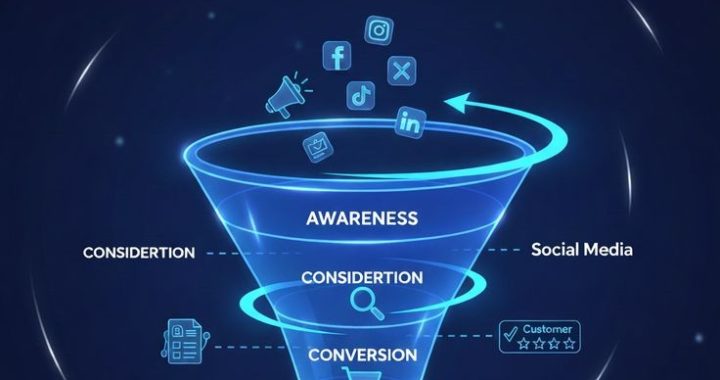
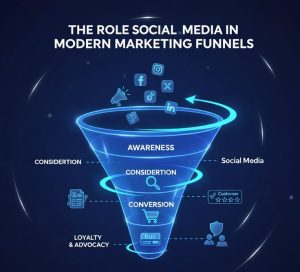
A marketing funnel is a visual way of representing the journey someone takes from first discovering your brand to finally becoming a paying, loyal customer.
It’s called a “funnel” because, just like a real funnel, it’s wide at the top and narrow at the bottom. A large number of people become aware of your brand, but only a smaller fraction of them eventually make a purchase — and an even smaller group becomes repeat, loyal customers.
Understanding this funnel matters because it tells you where people are dropping off, and what kind of message or action they need at each stage to keep moving forward.
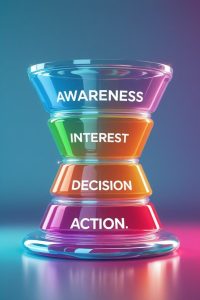
The Four Core Stages of a Marketing Funnel
While different marketers slice this up differently, most funnels boil down to four essential stages.

1. Awareness — “I didn’t know this existed”
This is the very top of the funnel, where someone first discovers your brand exists. It could happen through a social media post, a Google search, a friend’s recommendation, or an ad. At this stage, people aren’t ready to buy — they’re just noticing you for the first time.
What works here: Educational content, engaging social posts, SEO-optimized blog articles — anything that introduces your brand without pushing a hard sell.
2. Interest — “Okay, tell me more”
Once someone notices you, the next stage is building curiosity. They might read a blog post, browse your website, or follow your social media page. They’re evaluating whether you’re relevant enough to keep paying attention to.
What works here: Deeper content like how-to guides, product explainer videos, or comparison articles that build understanding and trust.
3. Decision — “Should I actually buy this?”
At this stage, the person is seriously considering a purchase but is likely still comparing options. They might check reviews, look at pricing, or read testimonials before making up their mind.
What works here: Clear pricing, customer reviews, case studies, limited-time offers, or a simple, reassuring FAQ section that removes last-minute doubts.
4. Action — “Alright, I’m buying it”
This is the narrowest part of the funnel — the moment someone actually completes a purchase, signs up, or takes the specific action you wanted.
What works here: A smooth, frictionless checkout process, clear calls-to-action, and reassurance like secure payment badges or easy return policies.

Beyond the Purchase: The Loyalty Stage
Many beginners assume the funnel ends the moment someone buys — but the smartest brands treat that moment as the beginning of a new relationship, not the finish line.
Loyalty — After a good experience, a customer might return, leave a positive review, or refer a friend. This stage turns one-time buyers into long-term supporters, and often costs far less to maintain than acquiring a brand-new customer from scratch.
Why the Funnel Concept Actually Matters
Without understanding the funnel, many beginners make the same mistake: they try to sell to someone who has never even heard of their brand. That’s like proposing marriage on a first date — it skips several necessary steps of trust-building.
The funnel forces you to ask a more useful question: “What does this specific person need to hear right now, based on how much they already know and trust me?”
A cold stranger needs an introduction. A curious visitor needs value. Someone comparing options needs reassurance. And a paying customer needs appreciation.
A Simple Example of a Funnel in Action
Let’s follow someone discovering our familiar candle brand:

Awareness: She sees a short video showing the calming process of hand-pouring candles, and pauses to watch.
Interest: Curious, she visits the website and reads a blog post about choosing scents for better sleep.
Decision: She’s interested but hesitant, so she checks the reviews section and notices genuinely happy customers describing the scent as “long-lasting and never overpowering.”
Action: A small limited-time discount on her first order nudges her to finally complete the purchase.
Loyalty: A week later, a simple, friendly follow-up email asking how she’s enjoying the candle makes her feel valued — and she ends up recommending it to a friend.
Each stage required a slightly different type of content and message. That’s the funnel working exactly as intended.

Common Mistakes Beginners Make With Funnels
Skipping straight to “buy now.” Pushing a sale on someone who just discovered your brand often backfires, since trust hasn’t been built yet.
Ignoring the after-purchase stage. Many businesses stop communicating right after a sale, missing a huge opportunity to build loyalty and repeat customers.
Assuming everyone moves through the funnel at the same speed. Some people take minutes to decide; others take weeks. Rushing everyone equally often costs you the ones who simply needed more time.
How to Start Thinking in Funnels
You don’t need complex software to begin. Start by mapping out, in simple terms:
How do people typically first discover you?
What builds their interest once they know you exist?
What convinces them to finally choose you over alternatives?
What happens right after they buy — do you say thank you, ask for feedback, or simply go silent?
Answering these four questions honestly often reveals exactly where your funnel is leaking potential customers.

What’s Next?
Now that you understand the journey someone takes toward becoming a customer, the next natural question is about the type of content that fills each stage of that journey. Specifically — what’s the real difference between content marketing, which builds trust slowly, and advertising, which pushes a message directly? That’s exactly what we’ll explore next.

Paid vs Organic Marketing: Where Should Beginners Start?

Paid vs Organic Marketing: Where Should Beginners Start?

If you’ve ever felt torn between “should I run ads?” and “should I just focus on growing naturally?” — you’re asking one of the most common questions in digital marketing. And the honest answer isn’t as simple as picking a side. It’s about understanding what each approach actually does, and when to lean on which one.
In our last two posts, we covered what digital marketing is and how SEO helps you get found organically. Today, we’re addressing the debate that trips up nearly every beginner: paid marketing versus organic marketing.
What Do “Paid” and “Organic” Actually Mean?
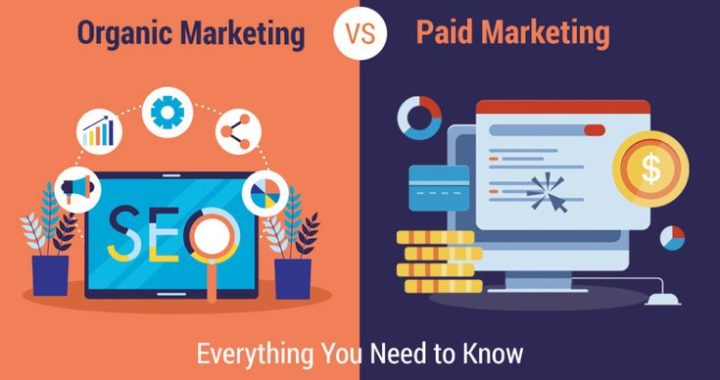
Organic marketing refers to any traffic or attention you earn without directly paying for placement — think SEO, social media posts, word of mouth, or content marketing. It grows naturally over time, built on relevance and trust.
Paid marketing refers to traffic or visibility you buy directly — search ads, social media ads, sponsored posts, or influencer partnerships you pay for. The moment your budget stops, so does the visibility.
Neither one is inherently “better.” They simply serve different purposes, and the smartest marketers use both, at different stages, for different goals.
The Core Difference: Speed vs Sustainability
Here’s the simplest way to picture it:

Paid marketing is like renting a shop in a busy mall. The moment you pay rent, people walk past and notice you. The moment you stop paying, that visibility disappears completely.
Organic marketing is like building your own storefront on a street corner. It takes longer to construct, and foot traffic starts slow — but once it’s built and people know it’s there, it keeps bringing customers back, month after month, without an ongoing rental bill.
Neither is wrong. A brand-new business often needs the mall’s instant foot traffic to survive early on, while relying purely on organic growth alone can feel painfully slow. But over years, that self-owned storefront often becomes the more valuable, cost-efficient asset.
Paid Marketing: The Fast Lane
Paid marketing includes things like:
Google Ads (search and display)
Instagram and Facebook ads
YouTube pre-roll ads
Sponsored influencer posts
LinkedIn sponsored content
The biggest advantage of paid marketing is speed. You can launch a campaign this afternoon and start seeing traffic within hours. It’s also highly targeted — you can choose exactly who sees your ad, based on location, age, interests, or even browsing behavior.
The tradeoff is that it’s a rented spotlight. Stop paying, and your visibility vanishes overnight. It can also get expensive quickly, especially in competitive industries where many businesses are bidding for the same audience’s attention.

Organic Marketing: The Long Game
Organic marketing includes things like:
SEO-optimized blog content
Social media posts and community engagement
Email newsletters built from genuine subscribers
Word-of-mouth and referral growth
The biggest advantage here is durability. A well-written blog post or a genuinely useful video can keep attracting visitors for years without additional spending. It also tends to build deeper trust, since people know you weren’t paying to be in front of them — you earned that spot.
The tradeoff is time. Organic growth rarely happens overnight. It can take weeks or months of consistent effort before you start seeing meaningful traction.
A Simple Way to Decide Where to Start
Ask yourself these three questions:
1. Do I need results immediately, or can I invest in the long term?
If you’re launching a time-sensitive offer or a new product that needs visibility right now, paid marketing gets you there faster. If you’re building a brand meant to last years, organic deserves serious early investment.
2. What’s my budget?
If your budget is tight, organic marketing lets you grow using time and effort instead of cash. If you have some budget to test with, even a small, well-targeted ad spend can help you learn quickly what resonates with your audience.
3. Am I trying to test an idea, or scale a proven one?
Paid ads are excellent for quickly testing which message, image, or offer performs best. Once you know what works, organic content can help you scale that same message more sustainably.
The Beginner-Friendly Approach: Start Organic, Use Paid to Accelerate
For most beginners with limited budgets, a hybrid mindset works best:

Step 1: Start building organic assets early — a blog, a social media presence, an email list. These take time to grow, so the earlier you start, the better.
Step 2: Once you notice which content or offers naturally perform well organically, put a small paid budget behind those proven winners to accelerate their reach.
Step 3: Reinvest what you learn from paid campaigns — which headlines work, which images get clicks — back into your organic content strategy.
This way, paid and organic aren’t competing strategies. They’re feeding each other.
A Real-World Example
Let’s return to our handmade candle business one more time. Early on, with a small budget, the owner starts a blog covering home fragrance tips — pure organic content, slow but free.
A few months in, one post about “cozy autumn scents” starts getting noticeable traffic on its own. Seeing this early signal, she puts a small ad budget behind that same topic, promoting it to a wider, similar audience. The ad performs well because the organic content already proved people cared about it.
That’s the paid-organic loop working exactly as intended — each one making the other stronger.
Common Myths Worth Clearing Up

Paid ads guarantee sales.”
Ads bring visibility and clicks, not automatic sales. Without a good offer, website, or clear message, paid traffic can disappear without converting into customers.
“Organic marketing is completely free.”
Organic isn’t free — it costs time, consistency, and effort, which are resources too. It’s “unpaid” in the direct financial sense, not effortless.
“You have to pick one and stick with it forever.”
Most successful brands blend both, adjusting the ratio depending on their goals, season, or budget at any given time.
What’s Next?
Whether someone finds you through a paid ad or an organic blog post, the real work has only just begun the moment they land on your page. That’s where the idea of a marketing funnel comes in — the journey that turns a curious stranger into a loyal customer. That’s exactly what we’ll unpack in the next post.

What Is SEO? How Search Engines Actually Rank Your Content

What Is SEO? How Search Engines Actually Rank Your Content 

Have you ever typed a question into Google and barely glanced past the first three results? Most people do exactly that — and if your business isn’t sitting somewhere near the top, you’re essentially invisible to a huge chunk of your potential audience. That invisibility problem is exactly what SEO exists to solve.
In our last post, we covered what digital marketing is as a whole. Today, we’re zooming into one of its most powerful pillars: Search Engine Optimization, better known as SEO.

What Is SEO, in simple terms ? 
SEO is the process of improving your website so that search engines like Google understand it, trust it, and show it to the right people when they search for something related to what you offer.
Think of Google as a giant librarian. Every day, millions of people walk up and ask questions. The librarian’s job is to hand them the most helpful, accurate, and trustworthy book from the shelves — instantly. SEO is essentially the work you do to make sure your “book” is the one the librarian reaches for first.
Nobody pays Google directly to rank higher in these natural results — that’s the “organic” part. SEO is earned through relevance and trust, not a paid placement.

Why Should You Actually Care About SEO?

Imagine two bakeries in the same city. One shows up on the first page when someone searches “fresh sourdough bread near me.” The other doesn’t show up at all, even though its bread might be just as good. Which one gets the customer?
That’s the quiet power of SEO — it brings people to you who are already looking for what you sell, without you having to interrupt them with an ad. A few reasons SEO matters so much:
It brings free, consistent traffic. Unlike ads, you don’t pay per visitor once you rank well.
It builds long-term trust. People trust organic results more than ads, since they feel earned rather than bought.
It compounds over time. A well-optimized blog post can keep bringing visitors for years, unlike a paid ad that stops the moment your budget runs out.
How Search Engines Actually Decide Rankings
Google doesn’t randomly pick which pages to show. Behind the scenes, it runs a complex, constantly evolving process to decide what deserves the top spot. Here’s a simplified breakdown of what’s really happening:

1. Crawling
Google uses automated programs, often called “bots” or “spiders,” that travel across the internet, jumping from link to link, discovering new and updated pages. If your site has never been crawled, it simply doesn’t exist in Google’s eyes yet.
2. Indexing
Once a page is discovered, Google reads and stores its content in a massive database, called an index. It tries to understand what the page is actually about — the topic, the intent, the quality.
3. Ranking
When someone searches a query, Google scans its index and ranks the most relevant, trustworthy, and useful pages at the top. This ranking depends on hundreds of signals, but a few matter far more than others.
The Big Ranking Factors That Actually Move the Needle
You don’t need to memorize hundreds of technical signals. Most of what matters boils down to these core categories:
Relevance — Does your content actually answer what the person is searching for? A page about “dog training tips” won’t rank for someone searching “cat food brands,” no matter how well-written it is.
Quality and depth — Thin, vague content rarely ranks well anymore. Search engines favor content that thoroughly answers a question, backed by clear explanations or examples.
User experience — Slow-loading pages, confusing navigation, or a site that looks broken on mobile can quietly kill your rankings, even if the content itself is great.
Backlinks — When other trustworthy websites link to your page, it acts like a vote of confidence. The more relevant, high-quality sites that link to you, the more Google trusts your content.
Freshness and consistency — Regularly updated, active websites tend to be viewed more favorably than ones that haven’t been touched in years.

The Two Main Types of SEO

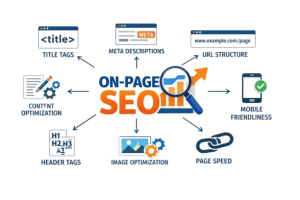
On-Page SEO
This refers to everything you control directly on your website — your titles, headings, content quality, images, internal links, and page speed. It’s the foundation everything else builds on.


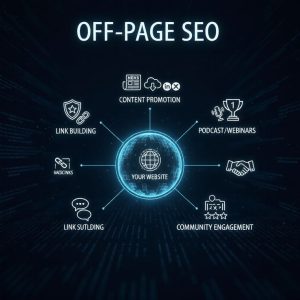
Off-Page SEO
This includes actions taken outside your website that influence your reputation, like earning backlinks from other sites, getting mentioned in articles, or building a recognizable brand presence across the web.
Both work together. Great on-page content with zero off-page authority struggles to rank. Strong backlinks pointing to a poorly written page rarely help either.
A Simple Example of SEO in Action : 
Let’s go back to our candle business from the last post. Suppose you write a detailed blog post titled “How to Choose the Right Candle Scent for Every Room in Your Home.”
If that post genuinely answers the question, loads quickly, is easy to read, and eventually earns a few links from home décor blogs — Google starts to notice. Over weeks and months, it may begin appearing when people search things like “best candle scents for bedroom” or “how to pick candle scents.”
That’s not luck. That’s SEO quietly doing its job, bringing in visitors who are already interested — without you spending a single rupee on ads.

Common SEO Myths, Cleared Up
“SEO is a one-time task.”
Not true. Search engines constantly update how they evaluate pages, and competitors are always publishing new content. SEO is ongoing, not a checkbox you tick once.
“More keywords equal better rankings.”
Stuffing a page with the same keyword repeatedly used to work years ago — today, it can actually hurt you. Search engines now prioritize natural, helpful writing over robotic keyword repetition.
“SEO results are instant.”
SEO is closer to planting a tree than flipping a switch. It typically takes weeks or months of consistent effort before real results show up — but unlike ads, those results tend to stick around far longer.
Where Should You Start?
If you’re just beginning, don’t try to master everything at once. Start small:
Pick topics your audience is genuinely searching for.
Write clear, genuinely useful content — the kind you’d want to read yourself.
Make sure your website loads quickly and works well on mobile.
Slowly build relationships that earn you natural backlinks over time.
SEO rewards patience and consistency far more than shortcuts or tricks.

What’s Next?
Now that you understand how search engines decide what deserves the spotlight, a natural question comes up: should you rely on this slow-and-steady organic approach, or invest in paid ads for faster results? In the next post, we’ll break down paid versus organic marketing, and help you figure out exactly where a beginner should start.

What Is Digital Marketing? A Beginner’s Roadmap for 2026

What Is Digital Marketing? A Beginner’s Roadmap for 2026

Picture this: you open your phone, scroll through Instagram, watch a YouTube video, check your email, and maybe order something online — all before you’ve even had your morning coffee. Somewhere in that fifteen-minute window, a brand tried to catch your attention at least half a dozen times. That, in the simplest possible terms, is digital marketing in action.

If you’ve ever wondered what digital marketing actually means beyond the buzzword, you’re in the right place. This guide breaks it down in plain language, no confusing jargon, no assumptions that you already know what a “funnel” or a “CTR” is. By the end, you’ll understand exactly what digital marketing is, why it matters, and how all its moving parts fit together.

So, What Exactly Is Digital Marketing?

Digital marketing is the practice of promoting products, services, or brands using digital channels — think websites, search engines, social media, email, and mobile apps — instead of traditional methods like TV ads, billboards, or newspaper listings.

In short: it’s marketing that happens wherever people spend time on a screen.

The goal hasn’t changed from traditional marketing — you still want to reach the right people, build trust, and eventually turn them into paying customers. What’s changed is the battlefield. Fifty years ago, a business fought for attention on a printed page. Today, it fights for attention in a crowded, scrolling, notification-filled digital space.

Why Digital Marketing Took Over

A few decades ago, if a small bakery wanted to advertise, its options were limited — maybe a local newspaper ad or a flyer on a community board. Reach was small, and results were nearly impossible to measure.

Now that same bakery can post a reel showing fresh croissants coming out of the oven, run a five-dollar ad targeting people within a three-kilometer radius, and track exactly how many people saw it, clicked it, and walked through the door. That’s the real power shift: digital marketing didn’t just move marketing online — it made marketing measurable, targeted, and accessible to businesses of every size.

Here’s why it has become the dominant form of marketing:

It reaches people where they already are. People aren’t waiting for the evening news to find out about new products; they’re already online, scrolling.

It’s measurable, down to the click. You can see exactly how many people viewed your ad, clicked your link, or abandoned their cart — something traditional billboards could never tell you.

It levels the playing field. A one-person business with a smart strategy can outperform a big brand with a bloated budget, simply by being sharper and more relevant online.

It’s flexible and fast. A traditional ad campaign might take weeks to launch. A digital campaign can go live in an afternoon — and be tweaked the moment it isn’t working.
The Core Pillars of Digital Marketing

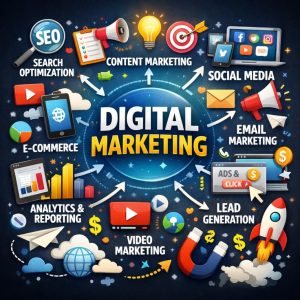
Digital marketing isn’t one single skill — it’s an umbrella term covering several connected disciplines. Think of it like a toolbox: each tool does a different job, but together they build the full picture.

1. Search Engine Optimization (SEO)

This is the practice of improving your website so it shows up naturally when people search on Google or other search engines. If someone types “best bakery near me” and your website appears on page one, that’s SEO doing its job quietly in the background.

2. Content Marketing

This is about creating valuable, useful, or entertaining content — blog posts, videos, infographics — that draws people in without directly shouting “buy now.” It builds trust first and sales later. This very blog post you’re reading is content marketing.

3. Social Media Marketing

Using platforms like Instagram, LinkedIn, YouTube, or Pinterest to build a community, share updates, and engage directly with your audience through comments, stories, and posts.

4. Pay-Per-Click Advertising (PPC)

Paid ads that appear on search engines or social platforms, where you pay only when someone actually clicks. It’s a fast way to get visibility while your organic efforts (like SEO) grow in the background.

5. Email Marketing

Despite being one of the oldest digital tools, email remains one of the highest-return channels available. It’s how businesses nurture relationships directly, without depending on an algorithm’s mood.

6. Affiliate and Influencer Marketing

Partnering with other creators or websites who promote your product to their own audience, usually in exchange for a commission or fee.

7. Analytics and Data

The behind-the-scenes engine of digital marketing. Every click, scroll, and purchase leaves a data trail, and analyzing that trail is how marketers know what’s working and what needs fixing.

Each of these pillars can be its own career path — but understanding how they connect is what separates a good marketer from a great one.

How Digital Marketing Actually Works: A Simple Example

Let’s say you run an online store selling handmade candles. Here’s how digital marketing might guide a single customer’s journey:

  1. Awareness — She discovers your candle through an Instagram reel or a Google search for “relaxing home fragrance ideas.”
  2. Interest — She clicks through to your blog post about the benefits of soy wax candles, and now recognizes your brand name.
  3. Consideration — She signs up for your email list after seeing a small discount pop-up.
  4. Conversion — A well-timed email with a limited offer convinces her to make her first purchase.
  5. Loyalty — After a great unboxing experience, she follows you on social media and becomes a repeat customer — maybe even tells a friend.

Every step in that journey involved a different digital marketing tool working together. That’s the real magic of digital marketing: it’s rarely just one tactic — it’s a coordinated system.

Common Myths About Digital Marketing

“It’s only for big companies with big budgets.” False. Some of the most effective digital campaigns come from small, local businesses that understand their audience better than a huge corporation ever could.

“Posting on social media is the whole strategy.” Social media is one piece, not the entire puzzle. Without SEO, email, or a clear website, posts alone rarely convert into long-term customers.

“It’s all about going viral.” Virality is a bonus, not a strategy. Sustainable growth usually comes from consistency, not a single lucky post.

Why This Matters for You

Whether you’re a business owner trying to grow, a student exploring career options, or simply someone curious about how brands reach you online, understanding digital marketing gives you a lens into how the modern world runs. Nearly every business — from a neighborhood tailor to a global tech company — now depends on some form of digital marketing to survive and grow.

And the best part? You don’t need a marketing degree to get started. You need curiosity, a willingness to experiment, and a basic understanding of the tools available — which is exactly what this blog series is here to build with you, one topic at a time.

What’s Next?

Now that you understand what digital marketing is at its core, the natural next question is: how do people actually get found on Google? That’s where SEO comes in — and it’s exactly what we’ll break down, in equally simple terms, in the next post.

Stay tuned, and welcome to the world of digital marketing.